Balancing Comfort and Crisis

WordPress Ai

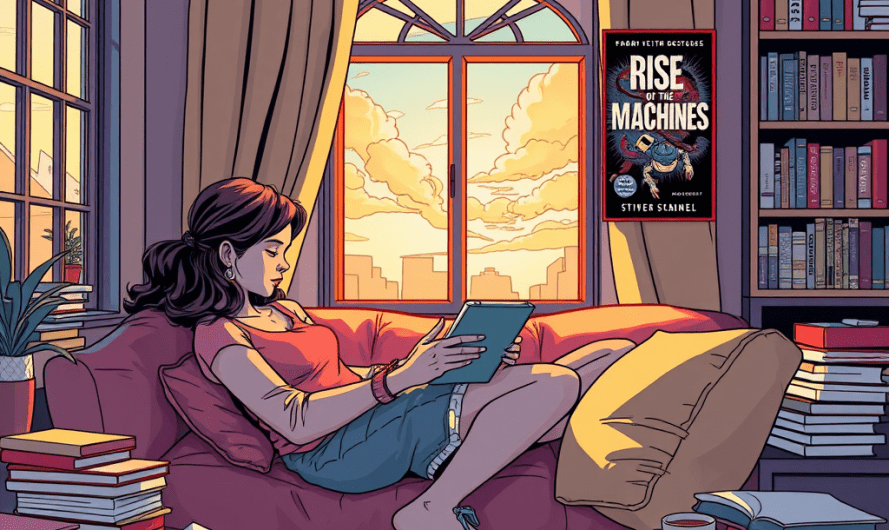
A shift is emerging in the genres. Some readers are seeking stories that prioritise comfort over conflict, seeking an escape, they say, from real-world stress – something they don’t get from tension-driven narratives.

Do the rise of cosy romance, the cosy mystery or the cosy fantasy suggest a trend? Are “no or low conflict” stories even possible? Are these requests for ‘no conflict’ prompted by something else?

Or is the term “conflict” the actual issue?

Readers are reporting being frustrated by traditional storytelling that ‘demands’ escalating tension and a third act crisis. This form of reader dissatisfaction might explain why “low conflict” is gaining a following. Think about it. perhaps writing a ‘low conflict’ story doesn’t require getting rid of every challenge a character faces. Perhaps writing a cosy does require the writer avoiding predictable and inorganic problems. Perhaps, ticking the boxes is not enough, especially if done carelessly.

Many readers equate the term, ‘conflict’, with high-stakes drama, acts of betrayal, that third-act ‘dark night of the soul’. But does that automatically mean our readers reject all forms of tension? Or are they rejecting characters suffering unfounded foreboding or baseless differences of opinion?

How many times can you recognise a trope unfolding without thinking: Not this again!

The Appeal of Low Stakes

Low stakes stories seem to opt for greater emotional resonance and a character-driven storytelling rather than plot twists. The stories focus on small, everyday moments. For readers who prefer comfort reads, the appeal is obvious.

Characters face challenges that feel proportionate and authentic rather than contrived or catastrophic.

At the same time, cozy mysteries still contain suspense, although it’s lighthearted. Cozy fantasy prioritises atmosphere over high-stakes adventure – hobbits’ hairy feet and elderberry wine rather than a clash of swords. Or of hearts.

A Story Without Conflict? Nah.

The biggest challenge for writers thinking to embrace the cosy has to be maintaining their balance.

Conflict remains the engine of storytelling—it’s what makes readers turn the page. Even low-stakes needs questions to create narrative momentum.  If every problem resolves too early, what is there to keep the story going?

“Conflict-free” stories risk feeling aimless. Characters meet half way through chapter one. After couple of chapters of mild social jockeying they become friends. They buy a pub together a couple of chapters later and in their spare time go on occasional hikes in the hills! This will be a pleasant experience for some. Others will find it dull.

You can’t get no Satisfaction?

The truth about trends, particularly this one, is obvious.

Some readers crave tension, excitement, while others seek warmth. Dark stories full of righteous anger, betrayal, and redemption remain popular, proving many readers continue to relish conflicted characters. And an occasional clash of swords. At the same time, cozy, slice-of-life mystery, romance and fantasy are flourishing, offering a different kind of satisfaction.

Trends are like fashion—some stick around, while others are best forgotten as quickly as last year’s miso soup craze. But if the thought of snuggling into “cosy” vibes does tickle your fancy, then aim to spice up your characterisation. Turn that bland setting into a plush wonderland that even a cat would envy! Remember to sprinkle in some atmosphere. I mean who doesn’t love lounging in their pajamas while engaging in daily rituals like 12-hour streaming binges?

Aim less for ‘what happens next’ and more towards ‘I am never leaving this world’.
That’s Not Tinnitus, That’s My Characters Talking In My Head…

Let’s face it. Writing can be a lonely job, even when you’re an introvert. While extraverts are off playing golf, meeting for coffee and cake or, heaven forbid, singing karaoke, we writers are crouched over our laptops, trying to transpose those voices from our heads onto the page and ultimately into a book. Yes, writing is something we must do in solitude.

Usually.

But, there is a place where we introverts can shine.

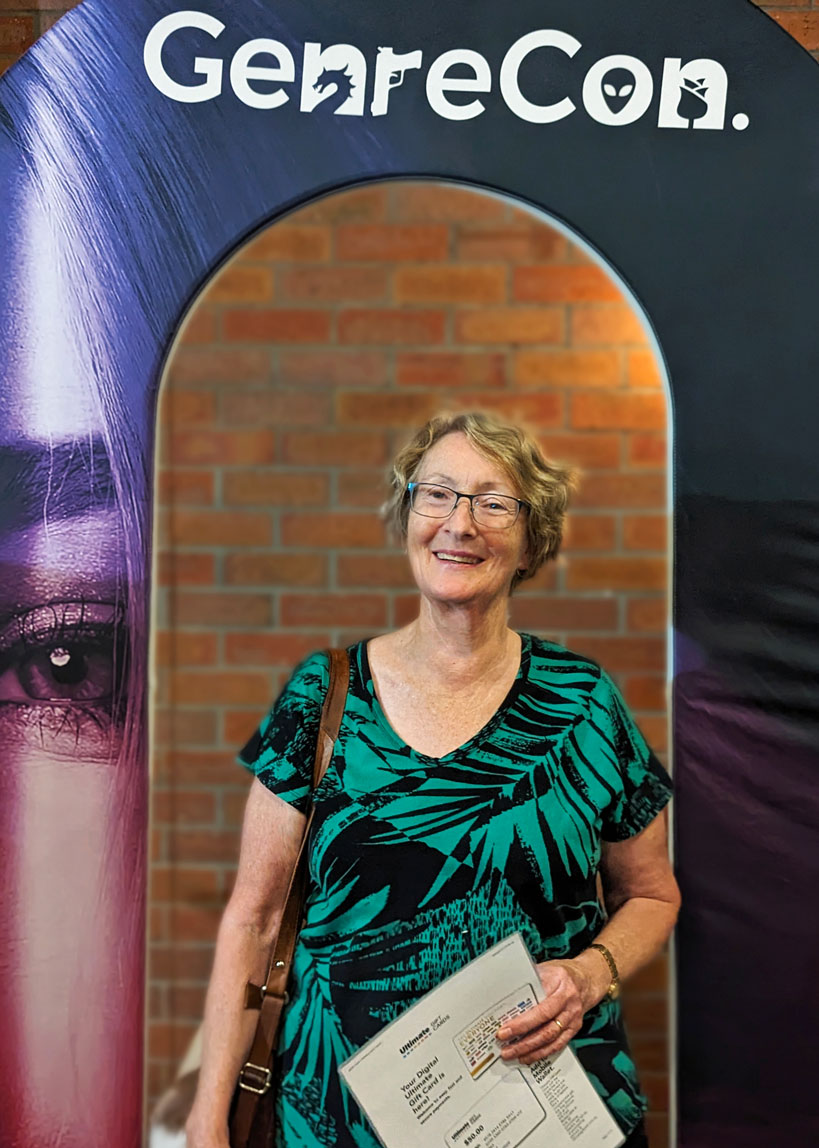
GenreCon is a place to hang with your tribe, soak up the words of successful authors, editors and publishers, and discuss ideas with people who already know about those voices in your head, because they have them, too.

Yes, once a year, writers can come together in the joyous celebration that is GenreCon. And yes, your heart should give a little flutter when you read the word, just like mine did when I typed it. And here is why: Every February the Queensland Writers Centre hosts a writing conference that brings local, interstate and international authors together at the State Library of Queensland. And it’s all achieved by the tireless work of the Queensland Writers Centre. How they manage to create such a miracle, I have no idea. I can’t even organise a chook raffle in a pub!
I’ve been to several GenreCons, and always come away bubbling with excitement, new stories leaping onto the pages of my notebook, more stories queueing in a disorderly fashion and squabbling to be put down on the page first. Honestly, I wish I’d never given up shorthand at school. This year’s GC, though, was almost like a roller coaster ride for me. It began when I won the GenreCon Short Story Award, and my story Smooth was read out by none other than the keynote speaker, Patrick Ness, a brilliant YA, Children’s and Adult writer and scriptwriter (think Dr Who). Now, winning was enough of a surprise, and for Patrick to read my story out on the launch night was sublime, but I even managed a few minutes chat with him afterwards.

Rubbing shoulders with internationally famous authors? Yes, anything is possible when you attend GenreCon. But wait, there’s more. Much, much more. But, you knew that already, didn’t you?
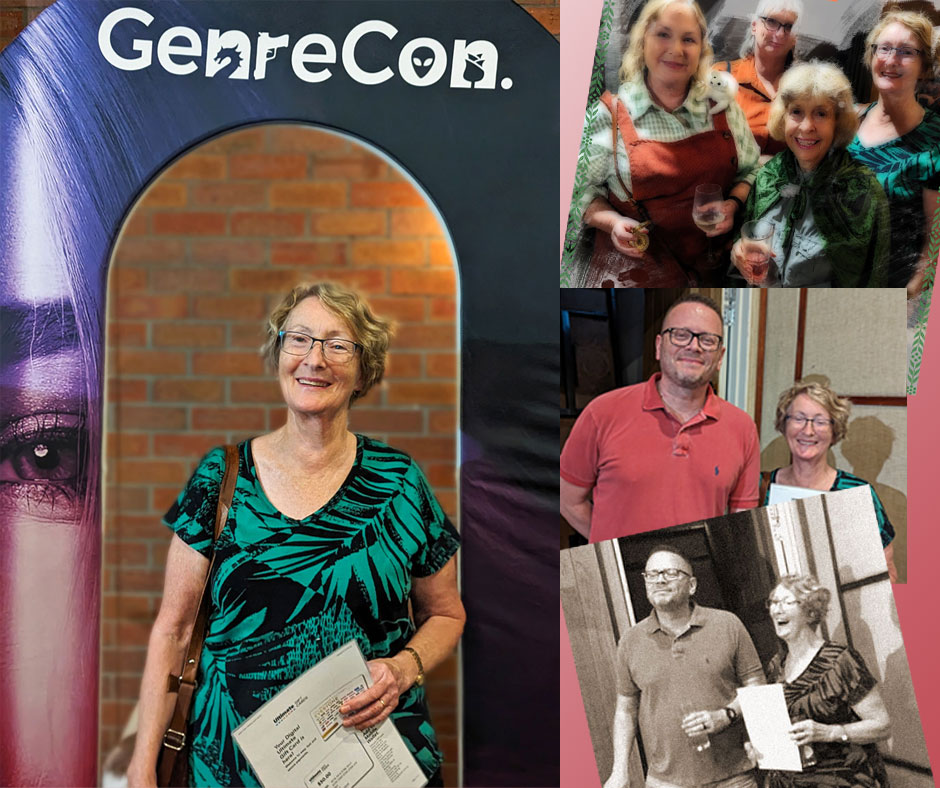
Being a writer of contemporary crime, historical crime and fantasy, I found the hardest thing about the three-day weekend was choosing whose workshop or panel to attend. Friday was a full-day workshop with Nick Earls on the Novella, and, with the novella’s recent rise in popularity, I jumped at the chance. I’m now halfway through writing two novellas. I told you GenreCon was inspiring. Saturday and Sunday were full of panels filled with authors, editors and publishers giving us their insights on new trends in publishing, as well as workshops on crime writing, sci-fi writing and getting into your villain’s head, to name a few.

There were talks on the craft of writing, how to write the crucial synopsis and cover letter, and a session on PR. Yes, an ugly word to many writers, but a necessary evil if we want to promote our product – our writing. Authors generously took us through their writing habits, how they created characters and plotlines, why they were driven to write these stories, and their experiences on their journey to publication. Julie Janson’s two-hour workshop on creating a crime novel was not to be missed.

I can see how my time at GenreCon has informed my most recent writing. Not only am I enthused to write more but I see an improvement in my writing itself. It’s more polished, more directed, I am able to clearly define my story’s plot-lines, my character’s arc, paring away the superfluous right down to the bones to build stronger prose.

I have the knowledge to direct my manuscripts to editors and publishers and give them my very best writing. I now have the skills to craft a tight synopsis and cover letter to accompany my manuscript to the publishers. And after a chat with a publishing house at GenreCon, my manuscript was requested for them to read. This particular pairing would not have happened except for GenreCon.

GenreCon is a long weekend where writers can learn, meet other writers and drink from the well of inspiration that only comes from writers gathering together and sharing their thoughts. Even little introverts like you and I can shine…and then escape back into our natural environment – the study, crouched over our laptops, wrapping the skin and bones around those voices in our heads.

Laree Chapman

I am extremely grateful to the Regional Arts Development Fund (RADF) for awarding me a Quick Response Grant to attend GenreCon 2024 in Brisbane. Their foresight in granting artists (and I include writers as artists) funding to help them attend festivals, events and workshops is greatly appreciated.

First Time for Everything

It’s been over a month since I attended GenreCon 2024, in Brisbane. 

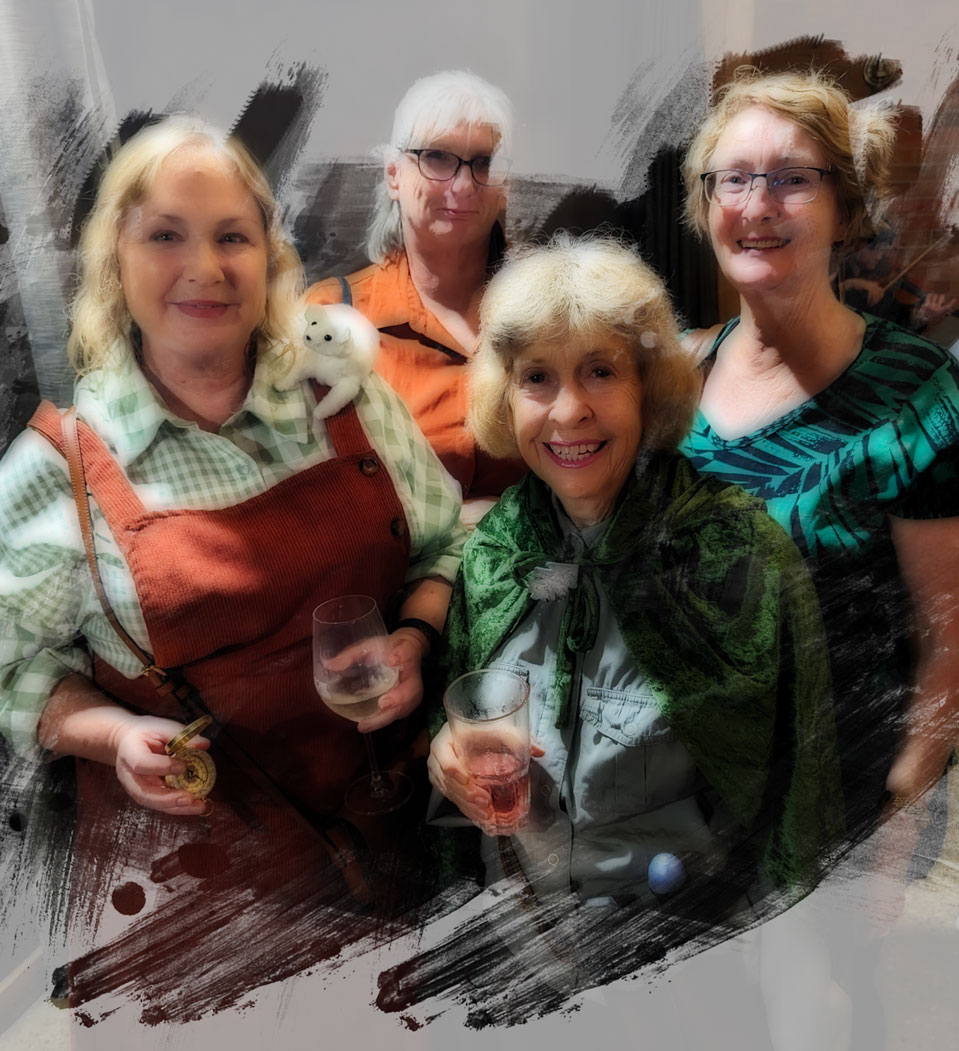
As a first timer at this, it was nice to have my friends from Bundaberg Writers Club with me. Laree Chapman, Sandy Curtis, and Jacqui Read were there to guide me through the intense schedule, and I won’t lie, it was full on. 

Fantabulous Fun: BWC members Jacqui, Gail, Sandy and Laree

The subjects covered were many and varied –– something for every type of writer: Fantasy, sci fi, romance, crime, memoir. All there under one roof. 

If you have had no experience of this sort of thing, it was stimulating to say the least.

A selection of workshops was available. The first one I attended was Nick Earls’ workshop “Writing the Novella”. 

I went into it thinking that it would just be a talk on how to extend a short story idea into a short novel. Nick’s workshop did cover that, but he also covered the popularity of the novella in today’s market. This had been the subject of his thesis, so he was pretty much on point with his reasoning, starting with busy lives and short attention spans of today’s readers. 

He also covered the how to contain the storyline, reduce the number of sub plots and how a novella is a good place to experiment with storyline, a chance to get into the detail of character and plot. 

During the workshop I couldn’t help thinking that my 80,000-word manuscript should be a novella. Later I was thinking that I probably had a novelette. By the time I left I was looking at a short story. 

Patrick Ness, keynote speaker, encouraged everyone to keep writing no matter what.  Don’t let anyone tell you that you can’t write. Write anything and everything. Short stories, articles, novels, memoirs, even letters. Just write. The other thing he said was overnight success takes years.

As an emerging crime writer, I was thrilled to hear from Rachel Amphlett about how she writes her crime novels. On the last day I attended an outstanding workshop by Julie Jansen about how to plot a crime novel. I gained a lot of inspiration from her and found I identified with her thought process. 

The big surprise for me was that my submission had been picked to be read out to the assembled crowd in “The Shreader [sic]”, a session where 5 selected submissions are read to a panel of writers and editors who decide if they want to read more, or it goes to the shredder.  It took me a while to realize that my words were being read out and you could have knocked me over with a feather, as the saying goes. It was such a boost when they said that they would be interested to read on. 

Don’t let anyone tell you that you can’t write. Write anything and everything. Short stories, articles, novels, memoirs, even letters. Just write.

An ability to network with industry professionals and gain insight to the inner working of how much goes on behind the scenes is essential. It is a part of an author’s business and today writing is a business.  We need to know what is expected of us, from the people who edit our manuscripts through marketing our work to what our readers want from us. Meeting new friends all at different stages of their writing was the icing on the cake.

This gathering of like-minded people at GenreCon is very much like a writing club on steroids. I thought I would feel out of place and time with everyone: writers, publishers, and editors. I thought I wouldn’t be ready to acknowledge the label of either author or writer, but I was wrong. 

I found the experience a great source of knowledge and inspiration.  I think this year I will be saving up for GenreCon 2025.

Gail Killen.


Coming to Bundaberg: How to Write Popular Fiction


Queensland Writers Centre and Bundaberg Writers Club will be hosting a two day workshop covering the A-Z of Writing Popular Fiction.

These interactive workshops suit beginners and emerging authors, or experienced writers who feel they need to refine their technique.

Venue: BWC Meeting Rooms, 80A Woongarra Street, Bundaberg Central.


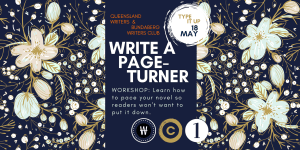
On Saturday, May 18

10.30am – 4.30pm

Learn how to pace your novel so that a reader won’t want to put it down.

Develop and  improve your writing skill-set through practical exercises and group discussion.

  • Create compelling hooks and story questions
  • understand the different pacing required in different genres
  • understand pacing needs to vary within a novel
  • learn how to slow or speed the pace of your story
  • recognise the boring bits, and have the courage to leave them out
  • learn how to ratchet up the tension in each page
  • understand how structure affects pacing

Book Now

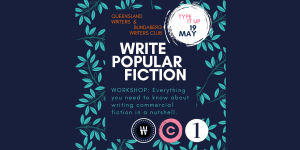
On Sunday, May 19

10.00am – 4.00pm

Everything you need to know about writing commercial fiction, in a nutshell

Explore key areas using practical exercises.

  • how to generate ideas and turn those ideas into a workable premise
  • investigate voice, and how voice relates to genre
  • Understand conflict, and how it generates plot
  • What is ‘classic story structure’?
  • Learn to develop a framework for your story
  • Learn about character arcs and how to show character growth and change.
  • Understand the commercial fiction market and pathways to publication


Book Now

Title Me Trivia October 6, 2018

Q: Aidan Turner loses his shirt in this latest television outing for Winston Graham’s story of 18th century Cornwall. Can you name the novel?

PS. Just curious.  Does the delightful Ross (played by Aidan) scything the field bare chested, or rising from the Cornish foam, improve the story, or enhance viewer experience, or both?

So, you’re writers, and readers, and movie goers. Right!  You know how, sometimes, the movie isn’t a patch on the book. And how occasionally the movie matches the book. And how seldom the movie exceeds the book. We could chat about this for ages, mostly because there are hundreds of adaptations to chat about and each is different.

The real question is, how many movies do you know of that started off as a short story or a novel? You might be surprised.

Why not CRASH the CRUSH Block Party, catch up with the club in Post Office Lane on October 6, and test your knowledge at AWESOME ADAPTATIONS. It’ll cost you $2pp to enter into a fast half hour of trivia testing, with three rounds between 5pm and 7.30 pm.

Yes, there is loot to collect. Books, naturally. We are a writers club.*

Kidslit                                                     AA Children's prizes

Mainstream                      AA Mainstream prizes

Comics                                                         AA Comics prizes

*

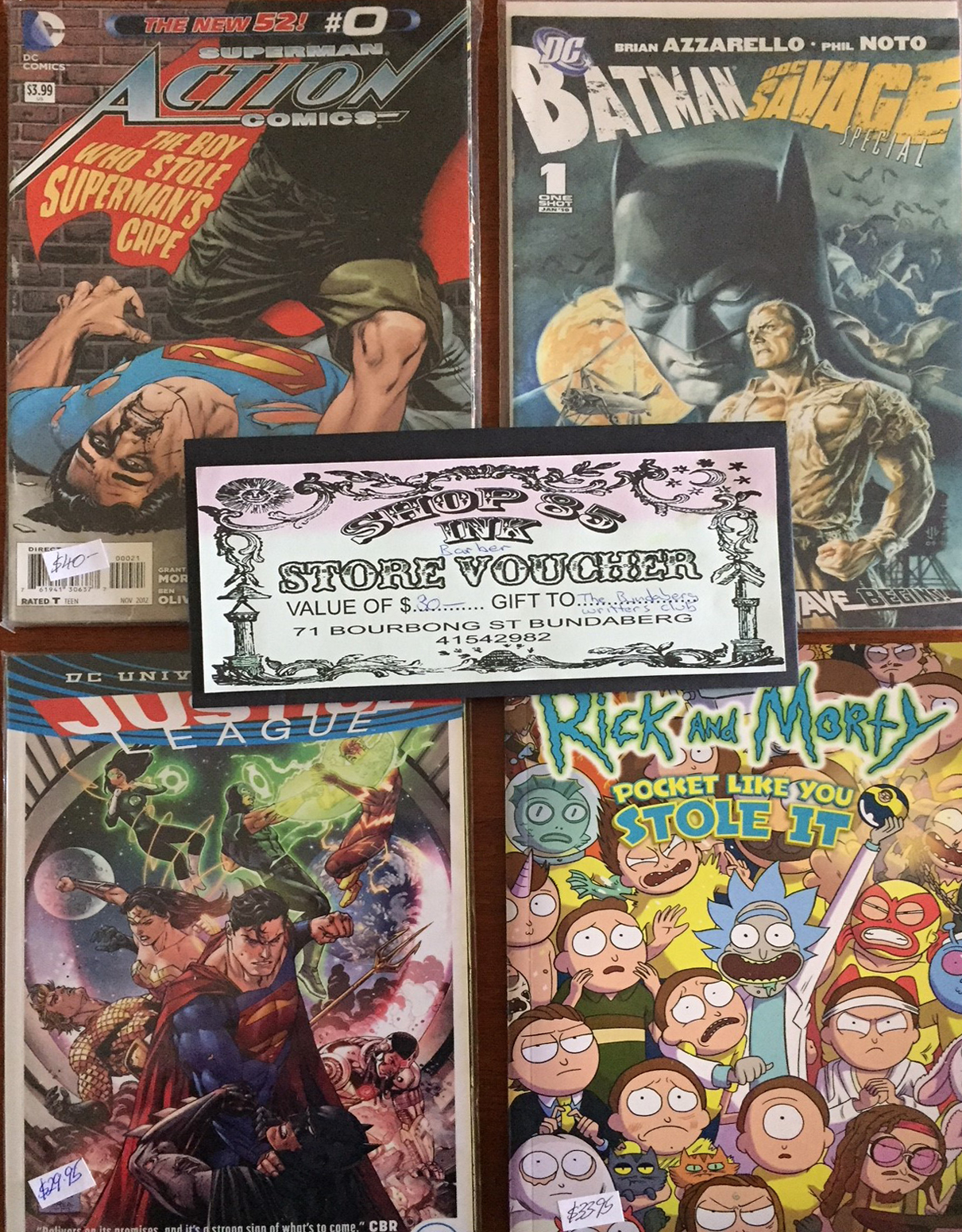
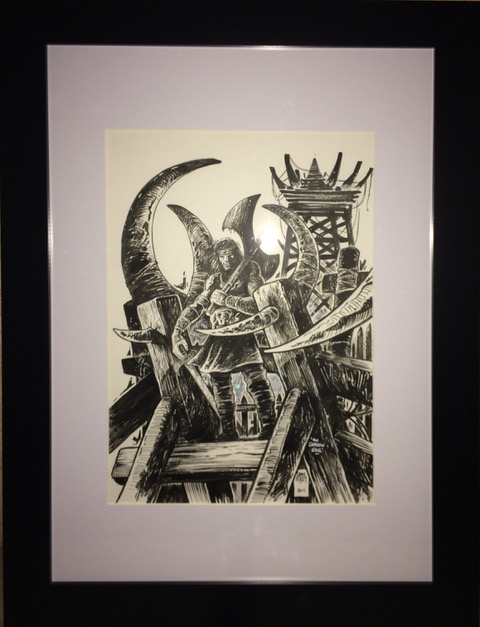
To be honest,  Shop 85, the comic book shop, as well as giving us comics, has included a little something unexpected, a $30 barber shop voucher for your favourite hairy hero. And for the true comic nerd, Bundaberg’s own Shane Foley (currently inking Phantom comics) has donated an original artwork, The Shadow King. IMG_1982

All you have to do for a chance to win is be there for the 7.30- 8pm slot – carrying that $2 entry fee.

Thanks to all the sponsors helping make Awesome Adaptations the best trivia event on the block.


sponsors.jpg

Oh, the answer to the challenge: Name the novel adaptation in which star Aidan Turner loses his shirt. It is, of course, Poldark.

Poetry’s Gift to Prose

Simon Kindt – Cool

Every now and then a book arrives full to bursting with an idea so thought provoking, or titillating, that nobody cares how well it’s written. Despite the novel’s faults, people who’ve hardly read books (let alone think about buying one) will see it for sale in a service station, or games emporium, or stacked in a toy store, and buy it just because they’ve heard the buzz this little slab of paper created.

Even while you shake your writerly head over them, you can’t deny the power of the ideas that gave us Fifty Shades, Ready Player One, Da Vinci Code (or even those Potter books).

The rest of us can’t rely on coming up with a world defining idea.

We’re going to have to haul ourselves out of the ordinary with our word skills, and that’s where the gift that is poetry enters the mix. While prose is all about sentences and what comes next, it’s the poetic eye (or is that ear) that adds the colour and feeling to the prosaic. When your writing is too flat, too ordinary, too bolted down to reality, it’s poetry that helps writers add sensory detail, playfulness, and a rich imagery deftly drawn.

Poetry is about nuance, about showing and suggesting connections. Story should be about nuance too, but it’s so easy to forget all that when your main aim is to achieve a word count.

And, of course, poetry is about language and how it fits together to create an effect as well as create a story.

Simon Kindt – in action

On Saturday, May 19, Queensland Writers’ Centre brought Brisbane poet, arts worker and teacher Simon Kindt, to us in Bundaberg.

The morning session, The Spaces Between: An Introduction to Poetic Writing   was an exploration of metaphor, imagery and writing for sound, designed for writers who want to test the notion that poetry can lift their words out of the doldrums.

The afternoon session focussed on bringing poetry off the page. Beyond the Page: Exploring Movement, Sound and Music  is for beginner and intermediate writers, and explores the power of sound and music intrinsic to poetry.

Two day Workshop: Writing for the Screen

Books and movies are like apples and oranges.  They both are fruit, but taste completely different.” Stephen King.

Do you dream of writing a movie – or a television show – but you’ve only ever written prose, articles, plays or short stories? What is it makes writing for a screen different than other forms of storytelling? Do you wonder how exactly you can take an idea from a blank page to a full length script?  Then this two-day workshop is for you. Bookings are now open for non-members of the club who might be interested in screen writing, but be quick, places are limited.

Bookings close Wednesday, April 4.  For more details or to secure a place, please contact The Secretary.

WRITING FOR THE SCREEN is a two-day workshop designed for storytellers who are new to the principles that underpin successful screen storytelling.

Over the two day workshop participants will be given a broad introduction to what they’ll need to know before embarking on writing a screenplay from scratch, or adapting a screen story from another source.

Participants will learn about the four pillars of story (character, plot, structure and theme). They will learn what differentiates screen writing from other forms of writing, how screenwriters develop their ideas into full scripts via the use of short documents, and, finally, what constitutes excellence/best practice in the screenwriting field.

Matthew Dabner, who was trained in screenwriting and producing at the University of Southern California’s school of Cinematic Arts. Matthew has been working in the film and television  industry for over twenty years developing and financing independent and studio-financed films, and working extensively as a script editor. Matthew has also taught screenwriting at the Australian Film Television and Radio school.

Participants will be provided with a produced screenplay ahead of the workshop to use as a reference example and as a tool for further analysis.

On the second day participants will have the opportunity to workshop their own one-page idea for a screen story and will be provided with the tools to continue developing their ideas into the future.

Where  : 80A Woongarra Street (Club Rooms)
When   : Saturday & Sunday, April 21 & 22.
Time    : 9.30am – 5pm (Saturday); 9.30am – 4pm (Sunday)
Cost     : $50 (non-members) – covers Saturday and Sunday sessions, morning and afternoon tea and coffee. BYO lunches, or take advantage of the near-by cafes. Club Members’ booking closed.

Remember, bookings close Wednesday, April 4.  For more details or to secure a place, please contact The Secretary.


Authors’ DIY Publicist Class

Can you afford to ignore this Masterclass?

Offered as part of WriteFest, this Masterclass from Jaki Arthur, Head of Marketing Communications, Harper Collins (Sydney) provides a unique opportunity for regional writers who are ready to put their work onto the public stage.

Authors think the biggest question they have to grapple with is whether to publish traditionally, or to self-publish.

In reality the biggest question revolves around how they will make sure their works reaches an interested audience.

jaki-arthurAsk yourself, are you a proactive author, ready to work with your publisher and publicist to garner your novel the success it deserves? Or are you a writer who likes DIY, and needs to know how the professionals do it?


Jaki has over 20 years of experience in book publishing in New Zealand, the UK and Australia across retail and publishing sales, marketing and publicity. She has run her own successful arts PR agency and is currently Head of Marketing Communications at HarperCollins publishers,  Sydney. Jaki has worked and toured with authors from all over the world publicising books across all genres.

This is an interactive and feedback-focused workshop. Jaki lets you in on well-kept publicity secrets. You can gain practical skills to help place your book in the hands of your target audience. Learn how to make yourself heard over all the yelling and hallooing.

It’s a Masterclass for aspiring writers, self-published writers and traditionally published writers.

Now really, can you afford to ignore this Masterclass?

Limited places available on Saturday, October 8 and Sunday, October 9Please book early

Jaki facilitated this Masterclass at the Sydney Writers’ Festival in 2015. Read The Guardian’s article about the Masterclass HERE.

Competition Winners Announced.

Thank you to everyone who submitted to this, our last short story competition for a little while. Although the competition has been especially successful, in our view, the club has decided to change focus for a couple of years to better service the needs of members.

Winner

Janice Williams for Tough Guy. Tough Guy

Janice describes the story as a ‘combination of working dog stories I have heard, and a recognition of the serious problem farmers face with depression.’

Judge’s Comment: Tough Guy is a gentle and moving story exploring the important and topical issue of depression rates amoung Australian farmers . It is well written with heart and humour, and a distinctively Australian voice. It builds powerful moments of drama through subtle characterisations and intimate moments.

Runner Up

Susan Bennett for Butterflies and Roses

Judge’s Comment: Butterflies and Roses has a sophisticated structure and delivers a great twist. Through clever writing and characterisation, it offers beautiful and unexpected insights on life and love.

Special Mention

Cameron England for  Close Contact

Judge’s Comment: Close Contact deals with compelling themes of climate change and isolation through excellent world-building. The dystiopian imagery and depth of characterisation are handled well through clear writing and subtle pacing, ending in a moment of high drama.

Short listed:

  • Mark Fowler Larrikin
  • John Pittmann Blame the Pink Umbrella
  • Carmel Lillis Submitted
  • Naomi Currie Honey Eater
  • Melanie Napthine Escape Artist

Meg Vann said: The standard of (short listed) stories overall was excellent. Each and every story offers terrific writing, characterisation and drama. The stories focussed on intriguing and topical themes, and all showed a sophisticated understanding of craft, using a high level of imagination and expression to create excellent narrative interest. It was very difficult to select the winners. I encourage all writers involved to keep honing their craft and sibmitting their stories to markets

Short Story 2016 Update

Meg Vann

Meg Vann

Meg Vann has agreed to be our final judge this year. She says she reads too much – loves crime and thrillers – eats too well, and is perpetually ready for adventure, which is undoubtedly why she is taking on our short list, which this year numbers eight.

For writers who may not yet be familiar with Meg Vann, she was for many years a core member of the Queensland Writers Centre, taking on the role of Chief Executive Officer for three of those years but always, always, always encouraging writers to dream of growing sustainable careers; to be valued and respected and enjoyed.

Meg is a writer, a digital experimenter, writing tutor, lecturer (now at University of Queensland) while studying criminology at Griffith, and convenor of Sisters in Crime (Brisbane Chapter).

We expect that we’ll be finalising the winner and runner-up by mid May, 2016, at the latest.

Good Luck to our final eight.