That’s Not Tinnitus, That’s My Characters Talking In My Head…

Let’s face it. Writing can be a lonely job, even when you’re an introvert. While extraverts are off playing golf, meeting for coffee and cake or, heaven forbid, singing karaoke, we writers are crouched over our laptops, trying to transpose those voices from our heads onto the page and ultimately into a book. Yes, writing is something we must do in solitude.

Usually.

But, there is a place where we introverts can shine.

GenreCon is a place to hang with your tribe, soak up the words of successful authors, editors and publishers, and discuss ideas with people who already know about those voices in your head, because they have them, too.
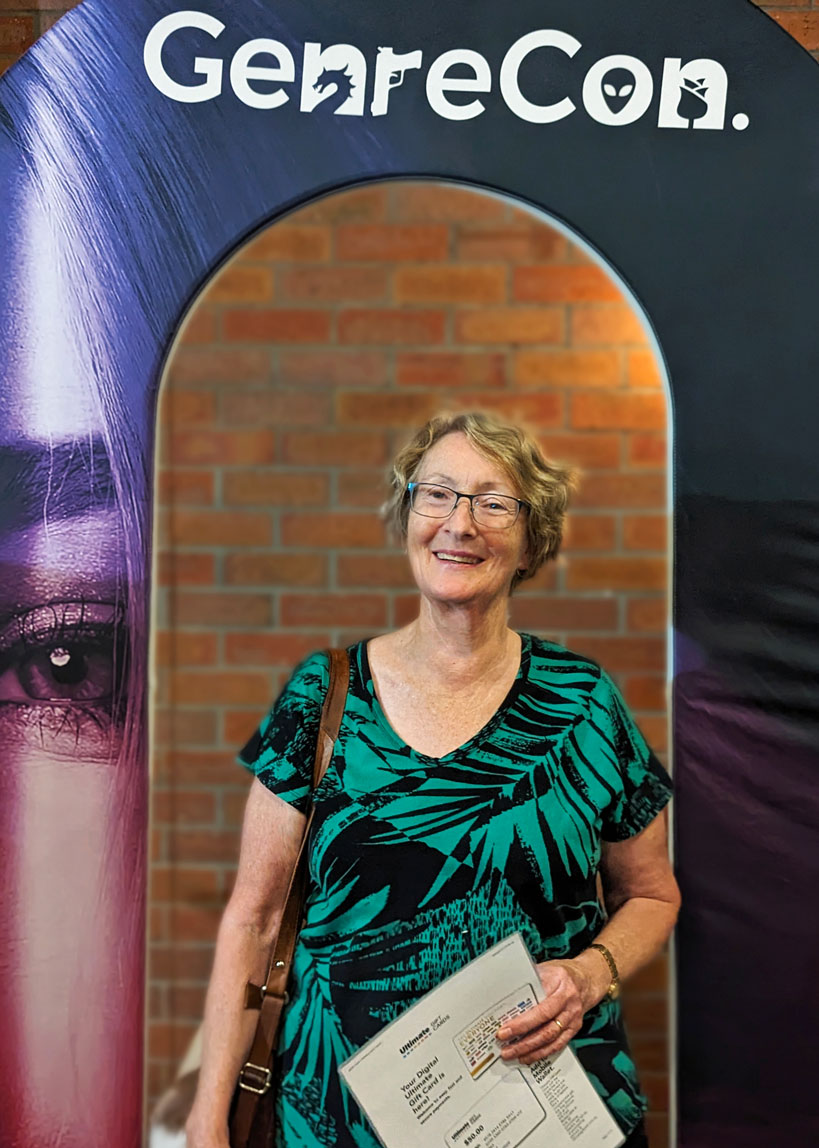
Yes, once a year, writers can come together in the joyous celebration that is GenreCon. And yes, your heart should give a little flutter when you read the word, just like mine did when I typed it. And here is why: Every February the Queensland Writers Centre hosts a writing conference that brings local, interstate and international authors together at the State Library of Queensland. And it’s all achieved by the tireless work of the Queensland Writers Centre. How they manage to create such a miracle, I have no idea. I can’t even organise a chook raffle in a pub!

I’ve been to several GenreCons, and always come away bubbling with excitement, new stories leaping onto the pages of my notebook, more stories queueing in a disorderly fashion and squabbling to be put down on the page first. Honestly, I wish I’d never given up shorthand at school. This year’s GC, though, was almost like a roller coaster ride for me. It began when I won the GenreCon Short Story Award, and my story Smooth was read out by none other than the keynote speaker, Patrick Ness, a brilliant YA, Children’s and Adult writer and scriptwriter (think Dr Who). Now, winning was enough of a surprise, and for Patrick to read my story out on the launch night was sublime, but I even managed a few minutes chat with him afterwards.
Rubbing shoulders with internationally famous authors? Yes, anything is possible when you attend GenreCon. But wait, there’s more. Much, much more. But, you knew that already, didn’t you?

Being a writer of contemporary crime, historical crime and fantasy, I found the hardest thing about the three-day weekend was choosing whose workshop or panel to attend. Friday was a full-day workshop with Nick Earls on the Novella, and, with the novella’s recent rise in popularity, I jumped at the chance. I’m now halfway through writing two novellas. I told you GenreCon was inspiring. Saturday and Sunday were full of panels filled with authors, editors and publishers giving us their insights on new trends in publishing, as well as workshops on crime writing, sci-fi writing and getting into your villain’s head, to name a few.

There were talks on the craft of writing, how to write the crucial synopsis and cover letter, and a session on PR. Yes, an ugly word to many writers, but a necessary evil if we want to promote our product – our writing. Authors generously took us through their writing habits, how they created characters and plotlines, why they were driven to write these stories, and their experiences on their journey to publication. Julie Janson’s two-hour workshop on creating a crime novel was not to be missed.

I can see how my time at GenreCon has informed my most recent writing. Not only am I enthused to write more but I see an improvement in my writing itself. It’s more polished, more directed, I am able to clearly define my story’s plot-lines, my character’s arc, paring away the superfluous right down to the bones to build stronger prose.

I have the knowledge to direct my manuscripts to editors and publishers and give them my very best writing. I now have the skills to craft a tight synopsis and cover letter to accompany my manuscript to the publishers. And after a chat with a publishing house at GenreCon, my manuscript was requested for them to read. This particular pairing would not have happened except for GenreCon.

GenreCon is a long weekend where writers can learn, meet other writers and drink from the well of inspiration that only comes from writers gathering together and sharing their thoughts. Even little introverts like you and I can shine…and then escape back into our natural environment – the study, crouched over our laptops, wrapping the skin and bones around those voices in our heads.

Laree Chapman
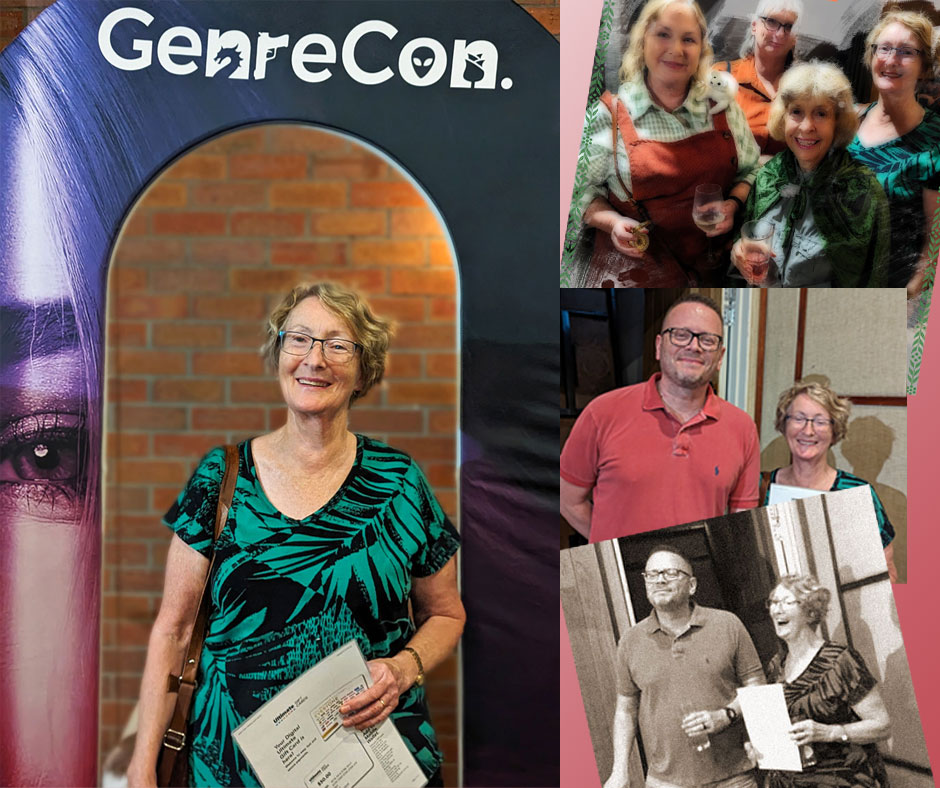
I am extremely grateful to the Regional Arts Development Fund (RADF) for awarding me a Quick Response Grant to attend GenreCon 2024 in Brisbane. Their foresight in granting artists (and I include writers as artists) funding to help them attend festivals, events and workshops is greatly appreciated.
First Time for Everything

It’s been over a month since I attended GenreCon 2024, in Brisbane. 

As a first timer at this, it was nice to have my friends from Bundaberg Writers Club with me. Laree Chapman, Sandy Curtis, and Jacqui Read were there to guide me through the intense schedule, and I won’t lie, it was full on. 

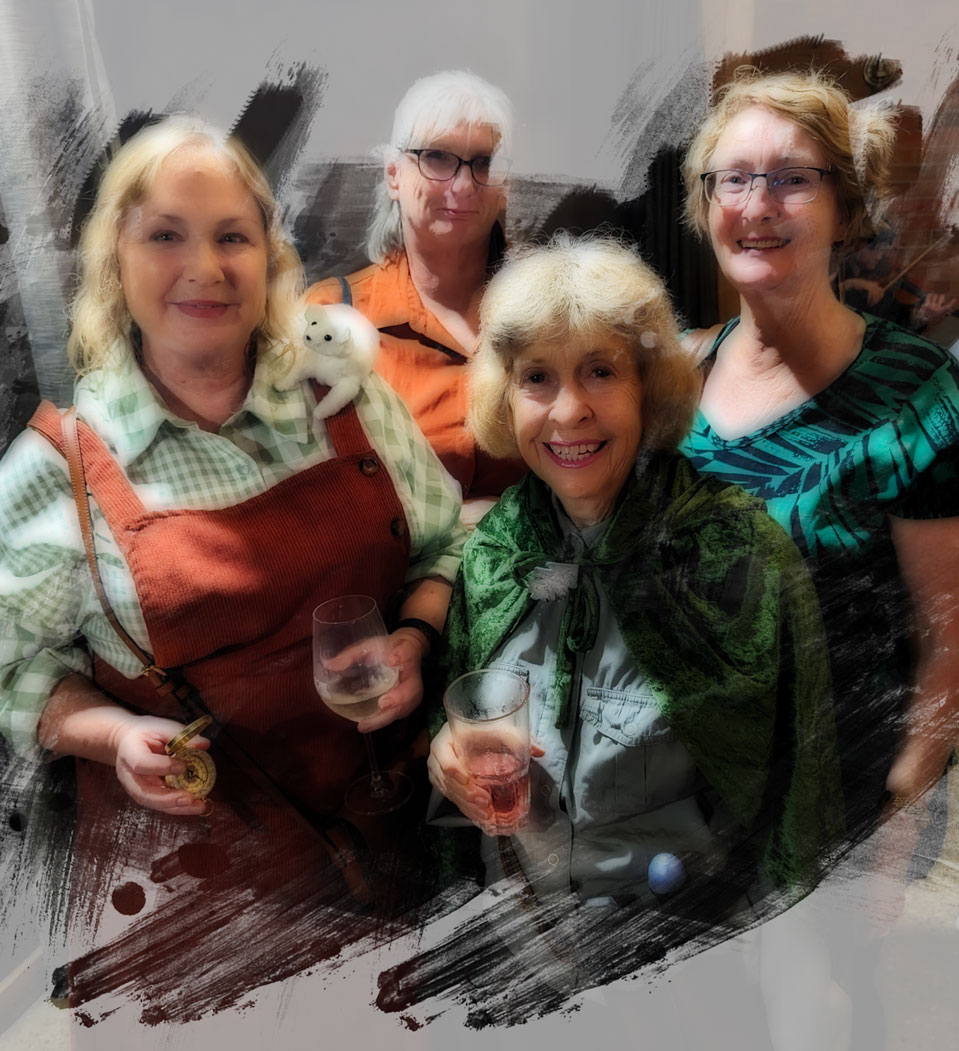
Fantabulous Fun: BWC members Jacqui, Gail, Sandy and Laree

The subjects covered were many and varied –– something for every type of writer: Fantasy, sci fi, romance, crime, memoir. All there under one roof. 

If you have had no experience of this sort of thing, it was stimulating to say the least.

A selection of workshops was available. The first one I attended was Nick Earls’ workshop “Writing the Novella”. 

I went into it thinking that it would just be a talk on how to extend a short story idea into a short novel. Nick’s workshop did cover that, but he also covered the popularity of the novella in today’s market. This had been the subject of his thesis, so he was pretty much on point with his reasoning, starting with busy lives and short attention spans of today’s readers. 

He also covered the how to contain the storyline, reduce the number of sub plots and how a novella is a good place to experiment with storyline, a chance to get into the detail of character and plot. 

During the workshop I couldn’t help thinking that my 80,000-word manuscript should be a novella. Later I was thinking that I probably had a novelette. By the time I left I was looking at a short story. 

Patrick Ness, keynote speaker, encouraged everyone to keep writing no matter what.  Don’t let anyone tell you that you can’t write. Write anything and everything. Short stories, articles, novels, memoirs, even letters. Just write. The other thing he said was overnight success takes years.

As an emerging crime writer, I was thrilled to hear from Rachel Amphlett about how she writes her crime novels. On the last day I attended an outstanding workshop by Julie Jansen about how to plot a crime novel. I gained a lot of inspiration from her and found I identified with her thought process. 

The big surprise for me was that my submission had been picked to be read out to the assembled crowd in “The Shreader [sic]”, a session where 5 selected submissions are read to a panel of writers and editors who decide if they want to read more, or it goes to the shredder.  It took me a while to realize that my words were being read out and you could have knocked me over with a feather, as the saying goes. It was such a boost when they said that they would be interested to read on. 

Don’t let anyone tell you that you can’t write. Write anything and everything. Short stories, articles, novels, memoirs, even letters. Just write.

An ability to network with industry professionals and gain insight to the inner working of how much goes on behind the scenes is essential. It is a part of an author’s business and today writing is a business.  We need to know what is expected of us, from the people who edit our manuscripts through marketing our work to what our readers want from us. Meeting new friends all at different stages of their writing was the icing on the cake.

This gathering of like-minded people at GenreCon is very much like a writing club on steroids. I thought I would feel out of place and time with everyone: writers, publishers, and editors. I thought I wouldn’t be ready to acknowledge the label of either author or writer, but I was wrong. 

I found the experience a great source of knowledge and inspiration.  I think this year I will be saving up for GenreCon 2025.

Gail Killen.


Coming to Bundaberg: How to Write Popular Fiction


Queensland Writers Centre and Bundaberg Writers Club will be hosting a two day workshop covering the A-Z of Writing Popular Fiction.

These interactive workshops suit beginners and emerging authors, or experienced writers who feel they need to refine their technique.

Venue: BWC Meeting Rooms, 80A Woongarra Street, Bundaberg Central.


On Saturday, May 18

10.30am – 4.30pm

Learn how to pace your novel so that a reader won’t want to put it down.

Develop and  improve your writing skill-set through practical exercises and group discussion.

  • Create compelling hooks and story questions
  • understand the different pacing required in different genres
  • understand pacing needs to vary within a novel
  • learn how to slow or speed the pace of your story
  • recognise the boring bits, and have the courage to leave them out
  • learn how to ratchet up the tension in each page
  • understand how structure affects pacing

Book Now

On Sunday, May 19

10.00am – 4.00pm

Everything you need to know about writing commercial fiction, in a nutshell

Explore key areas using practical exercises.

  • how to generate ideas and turn those ideas into a workable premise
  • investigate voice, and how voice relates to genre
  • Understand conflict, and how it generates plot
  • What is ‘classic story structure’?
  • Learn to develop a framework for your story
  • Learn about character arcs and how to show character growth and change.
  • Understand the commercial fiction market and pathways to publication


Book Now

Authors’ DIY Publicist Class

Can you afford to ignore this Masterclass?

Offered as part of WriteFest, this Masterclass from Jaki Arthur, Head of Marketing Communications, Harper Collins (Sydney) provides a unique opportunity for regional writers who are ready to put their work onto the public stage.

Authors think the biggest question they have to grapple with is whether to publish traditionally, or to self-publish.

In reality the biggest question revolves around how they will make sure their works reaches an interested audience.

jaki-arthurAsk yourself, are you a proactive author, ready to work with your publisher and publicist to garner your novel the success it deserves? Or are you a writer who likes DIY, and needs to know how the professionals do it?

Jaki has over 20 years of experience in book publishing in New Zealand, the UK and Australia across retail and publishing sales, marketing and publicity. She has run her own successful arts PR agency and is currently Head of Marketing Communications at HarperCollins publishers,  Sydney. Jaki has worked and toured with authors from all over the world publicising books across all genres.

This is an interactive and feedback-focused workshop. Jaki lets you in on well-kept publicity secrets. You can gain practical skills to help place your book in the hands of your target audience. Learn how to make yourself heard over all the yelling and hallooing.

It’s a Masterclass for aspiring writers, self-published writers and traditionally published writers.

Now really, can you afford to ignore this Masterclass?

Limited places available on Saturday, October 8 and Sunday, October 9Please book early

Jaki facilitated this Masterclass at the Sydney Writers’ Festival in 2015. Read The Guardian’s article about the Masterclass HERE.

Thoughts from the Back of the Room ~ Writing Tips We Love

A series of notes from Club Members:

Angus Gresham wrote for many years before becoming a club member. Since then he’s passed through many stages of learning, including having to reframe what he thought was ‘only commonsense’.
Writing is something everybody does, but all wannabe authors need to learn how writers do it differently, often alone and sometimes in the middle of creative chaos.

Angus Gresham

During my five years membership of BWC I attended various workshops, lectures, seminars and tutorials – all directed at improving one’s writing skills. I would hang on every word from the presenters and furiously scribble down copious notes – every word uttered seemed so important at the time; I couldn’t risk missing out on any of the gems of wisdom raining down. My notes were taken home, carefully filed and then largely forgotten. As a result a huge, unwieldy and somewhat illegible pile of papers accumulated.

Angus GreshamFinally I decided to do something about it. I pored over the years of note-taking in an attempt to determine what was worth rescuing. Some valuable writing tips were discovered among the mountains of more or less irrelevant scrawlings. Quite a few tips (the better ones) had been repeated over and over by various presenters. Some advice completely contradicted other advice.

The following is a sample of what I found useful. There has been no attempt to list in order of importance. For some people all the information provided may be of equal importance; others will find only some of the tips helpful.

**********

  • Don’t write unless you like doing it for its own sake. It would be great to be published and make lots of money, but if money is the primary focus, you won’t find writing enjoyable.
  • Read a lot, particularly in your chosen genre. When you read a good book, analyse what you like about it, and determine how you can use its positive elements in your own book.
  • Make notes, and plan months ahead of when you actually start the book.
  • You can use a working title which can be changed by you or your publisher at a later date.
  • One should only write for oneself, or for strangers; never for a set audience or family.
  • You’ve got to be happy with what you write. Do numerous drafts if necessary. Edit as much as you like.
  • First paragraph is crucial. You must hook readers from the very beginning. The real meaning of the first paragraph can be explained over the rest of the book. Conflict should start on page one.
  • End each chapter with a little bit of mystery, or even some excitement. This will ensure the reader keeps on reading to see what happens next.
  • Do emotions first, and structure last. You must feel compassion with, and become a part of, the characters. The reader should be able to identify with the characters and become emotionally engaged. Readers have to care about the characters – but they don’t necessarily have to like them.
  • Be aware of pace. Keep the pace moving. Delete all (or most) adverbs in your draft. This allows the story to flow much faster thus maintaining reader interest.
  • It’s OK to have short paragraphs; they give the reader breathing space. It’s OK to have short chapters; they give the reader a break.
  • Use internet research. It is much quicker than traditional library research. It may not be 100% accurate, but most of your readers are not experts on the subject you are writing about. The overriding importance is to tell a good, but believable, story. Wikipedia has a great overview on any topic.
  • Use your professional knowledge and life experience in your writing. Write about what you know. This saves having to do a lot of research.
  • Put your story away for a couple of months and then read it as if it’s someone else’s work. Does the story grab your attention and hold it through-out?
  • Read your story aloud. This will reveal any longwinded or awkward sentences.

Finally, you have to work out the system that works best for you.


Lovin’ & Genre Fiction

I’m not deep into the romance genre but I have to admit all my favourite reads contain aspects of romance – all the way from Homer to Lord of the Rings to the Jack Reacher novels of Lee Child.

Here I was thinking all I needed to do was master the art of the chilling clue or the perfect sword thrust when the unavoidable conclusion is that appropriate lovin’ also needs to be attempted.

Homer’s romances were responses to lust or to loyalty; Middle Earth’s  love affairs burned bright, but were seldom spoken of; Jack Reacher enjoys the meeting of physicalities driven by the practical requirements of ‘no baggage’.

One type of romantic interlude does not suit all and I’m hoping that at WriteFest 2016, to be held this year in October, Rachael Johns will be able to give this romance klutz some insights into creating an (appropriately weighted) romantic buzz between characters.

Rachael-Johns-high-resolution-195x220

Rachael Johns

Rachael is an English teacher by trade, a mum,  an arachnophobe and a writer the rest of the time. Her greatest reading loves are for romance and women’s fiction.

She has 15 published books to her name, including both digital first novellas and traditionally published novels. She writes as she reads, in the genres of rural romance, contemporary romance and women’s fiction. 

Rachael has a Bachelor of Arts (Honours) in Writing/English and a Graduate Diploma in secondary education. She teaches high school English and Drama, she has presented a wide variety of workshops, for example, at KSP Writers Centre and the Clare Writers Festival, and now at WRITEFEST.

Check out 2016

Late 2105 release from Queensland Writers Centre:

  • Books from our Backyard – for the fourth year, a catalogue of books published as advised by Queensland authors.
  • Programme, January -June. Check out the online courses. Be aware, if the fees are daunting, grants are available (try RADF [Regional Arts Development Fund] or local councils) for professional development.